

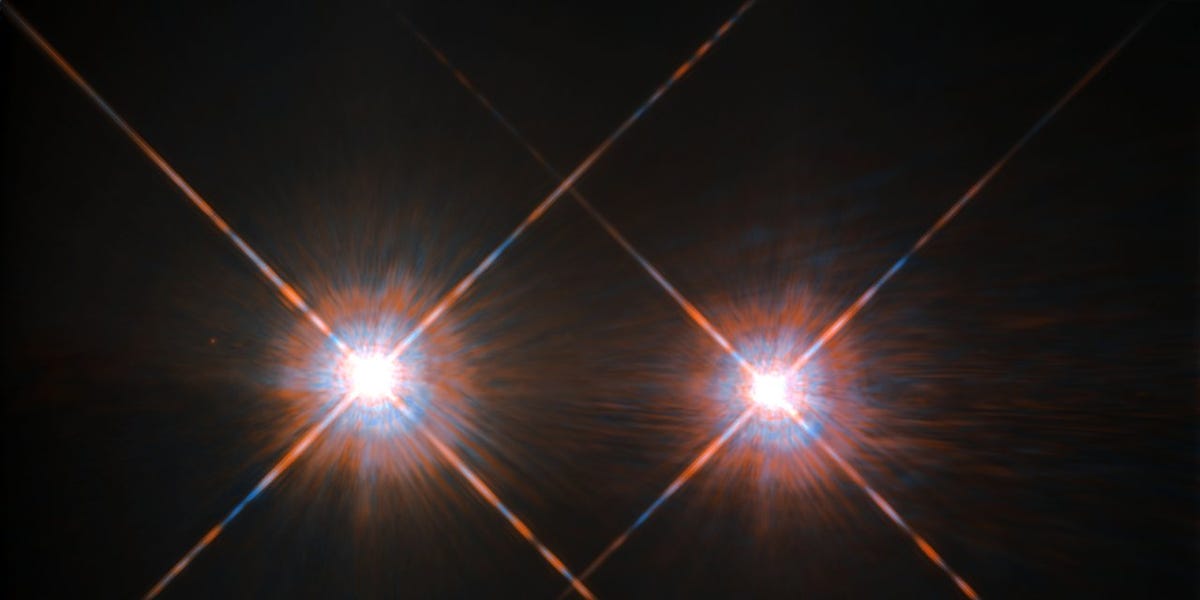
- Alpha Centauri is the star system nearest to our solar system, and it’s possible that material from there might have traveled over to us or may already be present within our celestial vicinity.
- To anticipate what might be encountered, scientists utilized current models to forecast the potential number of particles of various sizes that could already exist within our Solar System and potentially enter annually from Alpha Centauri.
- Examining the expulsion and movement of particles from Alpha Centauri might reveal insights into how matter is shared among different star systems.
While interstellar objects ( ‘Oumuamua Has anyone?) gone through our Solar System previously, the beginnings of numerous these items were shrouded in mystery. Were they created in a close vicinity? star Is it a faraway system? Perhaps one in an entirely different galaxy?
Sadly, it's not presently feasible to locate 'Oumuamua for additional research. Its highly eccentric orbit might go so far as to be unreachable by any spacecraft or unobservable by any telescope. However, this does not imply that we lack interstellar objects to study—on the contrary, it appears that we already have numerous particles from another star system within our reach.
The nearest star system to our location is this triplet of stars. Alpha Centauri It's currently approaching our solar system at a speed of 79,000 kilometers per hour (approximately 49,709 miles per hour) and will reach its nearest point roughly 27,700 years from now. Considering this, researchers Cole Gregg and Paul Wiegert from the University of Western Ontario set out to determine how many objects from Alpha Centauri may have already reached us and how many more might arrive in the future.
“Less than ten meteors might currently be entering Earth’s atmosphere each year,” Gregg and Wiegert stated in a study set for publication in the Planetary Science Journal , [and] is anticipated to rise as Alpha Centauri draws near.
Alpha Centauri is a mature star system, estimated to be around 5 billion years old. This indicates that the majority of the matter within its protoplanetary disk probably has already dispersed. As such, it isn’t anticipated to eject significant amounts of debris into space anymore; however, some materials from the Alpha Centauri system could potentially be found in our own asteroid belt and even farther regions. Oort cloud ). With that in mind, the gravitational influence of additional stars and planets increases the likelihood of material dispersal, and it might host planets circling its trio of stars (although none have been verified so far).
To find out if Alpha Centauri could be currently ejecting material, the researchers turned to existing models of how star systems usually eject debris. The models predicted that, despite the small number of objects from Alpha Centauri that are expected to make it all the way to Earth every year, there could be as many as a million over-one-hundred-meter-in-diameter-sized objects from the system already lurking in our Oort cloud (many smaller object and particles may also be among them).
The problem is that the Oort cloud is on the outer edge of the Solar System. This would make potential Alpha Centauri objects—if they really are somewhere in there—difficult to observe. Though, it wouldn’t be impossible. NASA’s New Horizons Mission has a dust detector actively picking up on particles In the Kuiper Belt, which could consist of remnants from the creation of our solar system, there’s also the more distant Oort Cloud. Even with a decreasing fuel supply, New Horizons might be capable of lasting long enough to head out there and search for signs of something originating from Alpha Centauri.
As mentioned, the existence of these entities remains uncertain. Additionally, smaller particles originating from Alpha Centauri might not withstand the voyage to our Solar System. These particles may veer off course due to potential deflections. magnetic fields , experience a significant slowdown because of drag from the interstellar medium, or face destruction through high-speed collisions with gas particles or among themselves.
For any particles that endure and succeed in reaching the inner Solar System, the Sun The gravitational pull of 's system will notably boost their speed. Additionally, more particles might originate from theoretical comets—assuming that Alpha Centauri expels as many as our solar system does—which could potentially be detected, although this is improbable. It still needs to be determined whether these possible particles can indeed be observed.
The comprehensive insight into how materials might move from Alpha Centauri to our solar system doesn’t just enhance our comprehension of interstellar travel," stated the researchers in their study, "it also uncovers fresh avenues for investigating the connections between star systems and the possibility of exchanging matter throughout. galaxy .”
Post a Comment